Primary 2 NH
Welcome to Mrs Hunter's Primary Two Class!
Numeracy - April - June 2026
Understand and use mathematical language when talking about their work. Solve everyday problems in the classroom. Recognise simple patterns and say what comes next. Number
· Count forwards and backwards in 1’s, 2’s and 10’s from any number answers within 50.
· Show that numbers between 10 and 20 can be made up of a “ten” and so many “ones”.
· Use complementary addition to work out ‘how many more’ to make a total.
· Use a number line to count back for subtraction within 20, recording calculations horizontally.
· Find the difference between two numbers within 20 practically.
· Solve problems using addition and subtraction skills, selecting the operation required. Money
· Investigate different combinations of all coins up to 20p to make a particular amount within 20p. Measures
· Understand and use analogue and digital clocks for half past times.
· Understand and use comparative language for weight, capacity, length and area. Shape and Space
· Compare the main 3D shapes (cube, cuboid, sphere and cylinder) and say how they are similar / different.
· Key in instructions for a controlled device (e.g. Beebot) to move from one specific location to another, estimating distances and using trial and improvement strategy Handling Data
· Talk about possible areas for data collection and represent this data using pictographs or block graphs (including ICT generated).
Literacy - April - June 2026
Talking and Listening:
· Convey simple information showing awareness of what the listener needs to know.
· Listen to and follow instructions accurately.
Sentence Construction & Punctuation:
· Understand the concept of a sentence and apply this understanding in reading and writing.
· Understand the concept of question and exclamation marks and apply this understanding in reading and writing. Reading
· Know the terms: ‘title’, ‘cover page’ and ‘blurb’ and use to predict.
· Understand basic story elements and make comparisons, e.g. beginnings and endings, characters, incidents and settings in different stories.
· Understand that non-fiction books on similar themes can give different information and present similar information in different ways.
Sounds-Write:
· Sounds where 2 letters represent 1 sound: <ck> <sh> <ch> <th> <wh> <ng> <qu>.
· Segmenting and blending sounds to read and write words with more than 3 sounds. E.g. drink, chest, things, pump
· Understand that one sound can be represented by more than one way e.g. <c>, <k>, <ck> and <l>, <ll> and <le>.
Handwriting:
· Write lower and upper case letters using the correct sequence of movements, ensuring the correct letter orientation to write on lined paper.
· Tall letters, small letters and ‘tails’ hanging below the line letters.
· Learn to write descenders on lines. Start to write on lines in books and begin to present work neatly.
Writing:
· Demonstrate an awareness of key features of narrative in writing, e.g. simple settings.
· Create short, simple texts on paper and on screen which combine words with images (and sounds).
World Around Us - April - June 2026
Our topic this term will be ‘Peter Rabbit’s Garden Adventure’. Some of the topics we will participate in are:
· Nature detective walk
· Practical planting and gardening activities.
· Investigate parts of a plant.
· Carry out scientific investigations.
· Go on a minibeast scavenger hunt.
· Investigate weather patterns.
· Explore the changing of the seasons.
· Participation in Forest School’s Lessons.
ICT -
· Express: Use JIT5 to write sentences about a given topic. Use shift key to use an upper case letter. Use full stops. Change font colour and insert pictures. Talk and present work.
· Explore: Programme Bee-Bot to move to a given point using a series of commands.
· Evaluate: Talk about ICT work to a teacher.
· Exhibit: Save work. Children can print work using the print icon.
Contact Details
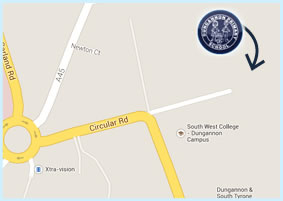
Dungannon Primary School,
Circular Rd,
Dungannon,
County Tyrone,
BT71 6BE
T: 028 8772 2250