
Primary 2 RH
Welcome to Miss Hall's P2 Class!
Numeracy - January - March 2026
We will be learning to:
Understand and use mathematical language when talking about their work. Solve everyday problems in the classroom. Recognise simple patterns and say what comes next.
Number
• Count forwards and backwards in 2’s from odd and even numbers within 20.
• Know the number “before”, “between” and “after” within 20.
• Practically subtract an amount from a set, within 20, as “take away”, “subtract” or “finding the difference”.
• Use number line to count on for addition within 20, recording calculations horizontally.
• Know doubles to 5 + 5.
• Understand the commutative property of addition.
P3
• Know the number “before”, “between” and “after” within 50.
• Find the position of any number on a blank 50 grid.
• Add numbers within 50 using a number grid, recording horizontally.
• Add 10 to any number using the 50 grid, using and explaining number patterns.
• Add a multiple of 10 to any multiple of 10 using the 50 grid.
• Know doubles to 10 + 10
• Subtract numbers within 50 using a number grid, recording horizontally.
Money
• Exchange higher value coins (up to 10p) for 1p’s.
• Calculate change required when buying items from 5p and then from 10p.
P3
• Calculate change required when buying items, paying with amounts up to 20p, then 50p.
• Use efficient methods to find the total of a mixed group of coins totals up to 50p.
Measures
• Understand and use analogue time: o’clock only.
• Understand and use digital time: o’clock only.
P3
• Understand and use half past and quarter past: analogue and digital time.
• Calculate durations involving hour and half past start and finish times.
• Understand am and pm.
Shape and Space
• Recognise and describe turning movements using appropriate terms (e.g. left, right, turn towards / away from)
P3
• Extend to follow and give instructions for movement, involving distances and turning movements.
Handling Data
• Use given one criterion Carroll Diagrams to sort for negation, explaining completed diagram (e.g. stating how many animals did not have 4 legs).
P3
• Use given two criteria Carrol Diagrams to sort for negation, explaining completed diagram.
Literacy - January - March 2026
Talking and Listening
• Recite poems and rhymes with some variety in pace, emphasis and intonation.
• Use different voices for characters when reading aloud.
Reading
• Learn about rhyme by exploring patterns orally, substituting words and phrases extending patterns and playing with rhymes.
• Know the terms ‘fiction’ and ‘non-fiction’, noting some of their different features e.g. layout, titles, contents page, use of pictures, labelled diagrams etc.
P3
• Understand time and sequential relationships in stories, i.e. what happened when
• Learn how to make links by discussing familiar story themes and linking to own experiences, e.g. illness, getting lost, going away
• Know how to predict, e.g. story endings/incidents
Sentence Construction & Punctuation
• Use the term ‘sentence’ appropriately to identify sentences in a text, i.e. those demarcated by capital letters and full-stops.
• Use features of punctuation to read in a phrased and fluent manner.
P3
• Recognise and take account of commas and exclamation marks in reading aloud with appropriate expression.
• Use knowledge about uses of capitalisation, e.g. for names, headings, titles, emphasis, and use in own writing
Phonics & Spelling
• Sounds~Write: Introduce sounds where 2 letters represent 1 sound <ll> <ff> <ss> <zz>.
• Rhyming CVCC and CCVC words.
P3
• Explore sounds where 2 letters represent 1 sound <ck> <sh> <ch> <tch> <th> <wh> <ng> <qu>.
• Rhyming CCVCC and CCCVC words.
• Segmenting and blending sounds to read and write words using one sound but different spellings e.g. all the different ways to spend the /k/ sound:- <c> cat , <ck> sock and <k> milk.
Handwriting
• Write lower and upper case letters using the correct sequence of movements , ensuring the correct letter orientation. Begin to write on lined paper.
P3
• Write legibly, with ascenders and descenders distinguished.
• Observe correct spacing within and between words.
Writing
• Use phonological and graphic knowledge and sight vocabulary when spelling during writing tasks.
P3
• Draw on knowledge and experience of texts in deciding and planning what and how to write.
• Write character profiles, e.g. simple descriptions, posters, passports, using key words and phrases that describe or are spoken by characters in the text.
World Around Us - January - March 2026
Our topic this term will be ‘Space Explorers’.
Some of the activities we will be involved in are:
• Find out about the planets and the solar system.
• Investigate journeys into space.
• Compare and contrast day and night.
• Explore the phases of the moon.
• Design and make a space buggy.
• Identify light sources and investigate how to make shadows.
• Explore push and pull forces through scientific investigations.
ICT -
Explore: Use ‘Scratch Jr’ to explore and interact with a digital device.
Express: Use microphone button to record and play back our own voice.
Exchange: Discuss how we communicate with people across the world through the use of phone (calls and messages)
Evaluate: Talk about their work. E.g. talk to the teacher about the picture they created on ‘Scratch Jr’
Exhibit: Show our ‘Scratch Jr’ projects to our classmates.
Contact Details
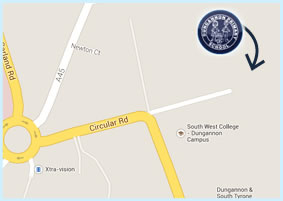
Dungannon Primary School,
Circular Rd,
Dungannon,
County Tyrone,
BT71 6BE
T: 028 8772 2250