
Welcome to Mrs Clayton's and Mrs Elliotts Class
Literacy - April - June 2026
Literacy
Communication:
Makaton
· Sign of the week
· Core Word of the Week
Talking and Listening:
Attention Skills
• Listening to a wide range of stories, poems, songs and music.
• Following instructions.
Phonological Awareness
• Identifying and manipulating phonemes.
Social Use of Language
• Understanding non-verbal signals.
• Adopting or assuming a role relevant to context.
Language and Thinking
• Talking about experiences, pictures and stories.
• Talking about their work, play and things they have made.
Extended Vocabulary
• Listening and responding to adults and peers.
Reading:
• Know how to handle and care for books.
• Listen to a range of stories, poems and non-fiction texts read to them by adults/other pupils.
• Read with some independence.
Writing:
• Distinguish between drawing and writing.
• Talk about the ideas represented in their drawings.
Numeracy - April - June 2026
Numeracy
Understanding Money:
• Use money in various contexts.
• Talk about things that they want to spend money on.
• Understand the need to pay for goods.
• Become familiar with coins in everyday use.
• Talk about different ways we can pay for goods, for example, cash and/or card.
• Use their number skills in shopping activities.
Measure:
• Talk about significant times on the clock, for example, lunch time, home time.
• Read o’clock and half past times on analogue and digital clocks
• Set an analogue clock to o’clock and half past times.
• Compare two intervals of time, talk about their observations in terms of took longer/shorter time.
• Explore time patterns, for example, morning afternoon, evening, days of the week.
• Choose and use, with guidance, non-standard units to measure time; talk about their work.
Topic Work - April - June 2026
Topic Work
My Body
· To name different parts of my body.
· To point to or show parts of my body when asked.
· To talk about what some body parts do (e.g., eyes help me see).
· To recognise that everyone’s body is special and different.
· To use words or pictures to describe my body.
· To look after my body by keeping it clean and healthy.
· To follow simple instructions to move my body (e.g., jump, stretch, clap).
Minibeasts
· To name some minibeasts (e.g., spider, worm, butterfly).
· To say where minibeasts live (e.g., under logs, in the garden).
· To describe what a minibeast looks like (e.g., legs, wings, colours).
· To sort minibeasts by simple features (e.g., has wings / no wings).
· To show care and respect for living things.
· To say that frogs and butterflies grow and change.
· To name the main stages (egg, tadpole, frog/ egg, caterpillar, chrysalis, butterfly).
· To put the stages in the correct order and to recognise the difference between each stage.
· To describe what happens at each stage in simple words.
· To match pictures of each stage.
Contact Details
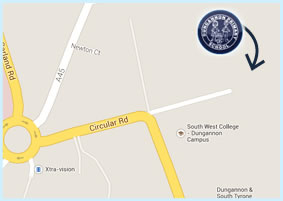
Dungannon Primary School,
Circular Rd,
Dungannon,
County Tyrone,
BT71 6BE
T: 028 8772 2250