
Primary 6 SA
Welcome to Mrs Alexander's Primary 6 class.
Numeracy - April - June 2026
Number
Know equivalence of simple fractions where the numerator is not 1.
Find fractions of quantities where the numerator is not 1
Demonstrate value of any 1 d.p. number within 99 999 in terms of ten thousands, thousands, hundreds, tens, ones (units).
Round 1 d.p. numbers to the nearest whole number.
Recognise simple percentages (10%, 20%, 25%, 33 1/3 % 50%, 100%) and know their equivalent fraction. Use this knowledge to solve simple problems.
Mentally calculate 50%, 25%, 10% of a quantity.
Develop a standard written method for vertical addition 10th Th H T U, including decimal numbers with up to 1 d.p. (no exchange, then with exchange), estimating the answer before calculating.
Measures
Apply knowledge of metric units of length to real life contexts, including estimating, selecting appropriate units and measuring equipment, involving up to 1 d.p.
Understand concept of scale in maps and diagrams.
Apply knowledge of metric units of capacity to real life contexts, including estimating, selecting appropriate units and measuring equipment (interpreting different scales effectively), involving up to 1 d.p.
Calculate areas of squares and rectangles, and simple composite shapes.
Appreciate need for standard unit of volume.
Understand that a cubic cm is a cube of side length 1cm, whose volume is 1cm3 .
Estimate and measure volumes of cubes and cuboids using cm cubes.
Interpret timetables using 24 hour time system.
Use a thermometer to measure temperature, and calculate temperature increases and decreases, including negative values.
Shape & Space
Classify triangles according to their particular properties, and so define equilateral, isosceles, right-angled and scalene triangles.
Data Handling
Find Mean and Range of a set of data.
Design and use a decision tree to sort and classify objects.
Construct computer database, identifying number and type of fields required, and use to enter and extract information relevant to a topic.
Identify events which have an equal chance of occurring as not occurring, and describe as “even chance”.
Mental Maths
Mentally find doubles of any 2 digit number up to double 50 and derive corresponding halves.
Mentally add two 2 digit numbers, bridging the ten, answers within 100.
Mentally add a two digit multiple of 10 to a 2 digit number and vice versa, bridging through 100.
Literacy - April - June 2026
Talking and Listening
· Explain and justify methods opinions and conclusions.
· Become self-directed by working on their own or with a group.
· Consider how working in role helps to explore complex issues.
· Perform a scripted scene making use of dramatic conventions.
Reading (At appropriately differentiated levels)
· Understand the concept of point of view from which a story is told and how this affects the reader’s response.
· Understand that stories and poems emanate from different cultures and traditions.
· Know how to change point of view.
· Know and understand the features and purposes of persuasive texts.
· Understand and evaluate how letters are intended to inform, protest, complain and persuade.
· Know how to identify persuasive techniques in texts such as newspapers, comments, headlines and adverts.
Writing (At appropriately differentiated levels)
· Write from another character’s point of view.
· Record predictions, questions, reflections while reading.
· Write on to complete a section, resolve a conflict and write additional information.
· Draft and write individual letters for real life purposes.
· Write persuasively on an issue, setting out and justifying a personal view.
· Use a dictionary, thesaurus or other appropriate source in the construction of a persuasive argument.
World Around Us - April - June 2026
Our topic this term is Forces in Action. Throughout this topic children will have the opportunity to:
• Identify different forces in action.
• Explain that unsupported objects fall towards the Earth because of the force of gravity acting between the Earth and the falling object.
• Identify the effects of friction that act between moving surfaces and are beginning to explain these effects.
• Identify the effects of air resistance.
• Identify the effects of water resistance.
• Recognise that some mechanisms, including levers, pulleys and gears, allow a smaller force to have a greater effect.
• Label forces in a diagram more independently and begin to explain what the forces are doing.
• Record data in a table when comparing the weight and mass of objects.
• Plot a bar graph to present their results and use this to reach a conclusion.
• Plan and carry out a comparative test to answer a scientific question, recognising and controlling variables.
• Measure and compare the sinking times of different shapes of modelling clay to investigate how shape affects water resistance.
• Present their research findings on a specific type of mechanism to teach and inform their peers.
Contact Details
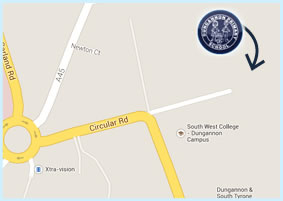
Dungannon Primary School,
Circular Rd,
Dungannon,
County Tyrone,
BT71 6BE
T: 028 8772 2250