
LSC D
Welcome back to LSC D & Happy New Year
Dear Parents,
Thank you for all your support through Term 1, it has been greatly appreciated. We are delighted to hear that the boys and girls had a great Christmas break and have settled very well back into classroom routines. I have included a new overview of what your children will be engaging with in our Learning Support class this term.
Please note:
· PE days have currently changed to a Monday (Indoor PE) and a Wednesday (Outdoor PE, weather permitting).
Literacy - January - March 2026
Writing:
· Recognise the importance of constructing complete sentences using the rule of including a ‘subject, verb and object’.
· Use colourful semantics to visualise the use of ‘who, doing and what’ to support early readers and writers.
· Reinforce learning from previous term on the identification of nouns, verbs and adjectives in both spoken and written language.
· Encourage pupils, where possible, to use descriptive language to enhance their writing, making it more vivid and engaging.
· Use prompts, visuals and story starters to inspire writing and help pupils practice structuring their thoughts and experience creative writing.
· Use shared writing experiences to foster a supportive environment and encourage peer learning opportunities.
· Weekly structured handwriting sessions to improve their form and legibility.
Reading:
· Three guided reading sessions are completed weekly by teacher and classroom assistants.
· Reading books are individualised to each pupil’s capabilities and to promote confidence and fluency.
· High Frequency Words activities are completed weekly for pupils and are planned on an individualised basis.
· Working on open-ended questions to encourage critical thinking, such as: “What do you think might happen next?”; “How would you feel in the character’s situation?”, “How do you think the character feels and why?”
· Where appropriate pupils are encouraged to support their answers with evidence from the text.
· Developing a love for reading by class library visits beginning in February on a monthly basis to the local library; allowing pupils to explore new books and encourage pupils to choose books that interest them.
Spelling & Phonics:
· Continue to work on individualised phonics programs tailored to each child’s leaning needs, focusing on sound recognition and spelling patterns.
· Incorporate phonics activities throughout the week that reinforce sound-letter relationships and spelling rules in line with our Sounds-Write scheme.
· Pupils access a multisensory approach to spelling to reinforce learning, such as paint, sand, play dough, puzzles and games.
Homework & Communication
To ensure homework meets individual needs, we have been completing assessments, with the plan to distribute homework packs at the start of October. Children will bring home familiar reading books which we encourage you to read together throughout the week. Weekly spelling and numeracy activities will also be provided. If homework presents any challenges, please feel free to reach out to me and discuss further.
Numeracy - January - March 2026
Mental maths:
· Working on the importance of quick recall and recognition of number facts, including addition, subtraction and multiplication and division facts, tailored to individual needs.
· Homework will focus on practicing these facts, even when answers are provided, we encourage mental agility and quick recall.
· Mental maths strategies of counting on, counting back, doubling, halving, rounding and adjusting and partitioning will be used as appropriate.
Number:
· All number learning intentions and activities are differentiated to each individual pupil.
· Hands-on activities are used to provide opportunities for pupils to work with manipulatives such as counters, numicon, blocks, and natural objects.
· A range of both practical and textbook work is used to ensure a balanced approach to learning.
· Pupils are encouraged to explain their reasoning and problem-solving processes in their written work.
Topic Maths:
· Continuing to consolidate learning from the pervious term by exploring the properties of different 2-D and 3-D shapes.
· Engage pupils in identifying and classifying shapes based in their attributes such as faces, edges and vertices.
· Begin exploring measurement focusing on length and weight.
· Conduct practical measurement activities using non-standard (steps, paperclips, pencils) and standard units of measurements (mm, cm, m) to measure a range of objects indoors and outdoors.
· Conduct practical measurement activities using balancing scales and weighing scales to measure weights of a range of objects.
· Recognise and use appropriate language associated with length – long, short, longer, shorter, centimetres, meters.
· Recognise and use appropriate language associated with weight – heavy, light, heavier, lighter, balance, same as, grams, kilograms.
· Money related activities incorporated into Numeracy taskboards on a weekly basis to promote functional life skills.
World Around Us - January - March 2026
Materials Topic (Jan – March)
We are learning about the importance of materials and their properties and their connection to everyday life and the world around us.
Science:
· Exploring the characteristics of materials such as hardness, flexibility, transparency and waterproofing.
· Conducting simple experiments to these properties (e.g. which materials are waterproof).
· Discuss why specific materials are chosen for objects (e.g., glass for windows, rubber for tires).
· Engage in hands-on activities, like creating a chart comparing different materials and their uses.
History:
· Examine how materials have been used throughout history (e.g. wood in ancient tools, metals in weapons).
· Discuss significant historical advancements due to materials innovations (e.g. the Bronze Age, Industrial Revolution).
· Explore how different cultures utilise materials unique to their environment (e.g. adobe in desert regions, bamboo in tropical areas).
· Encourage children to research materials used in their own cultural backgrounds.
Geography:
· Learn about where different materials come from (e.g., metals from mines, cotton from plants).
· Discuss the geography of materials: how climate and environment influence material availability (e.g., marble from mountains, clay from riverbanks).
· Discuss how we import and export materials from different countries.
· Discuss sustainability and the impact of materials choices on the environment.
To allow the learning above to be accessible for all pupils, we will use visual aids of pictures and diagrams; have hands-on practical activities to allow pupils to touch and compare materials; ensure language is simplified appropriately for the needs of each child and encourage pupils to engage in questions and discussions to promote a deeper understanding. We invite you to participate in discussions at home about materials and their uses and will suggest through SeeSaw some simple home projects where pupils can explore materials around their house and share findings with the class.
Contact Details
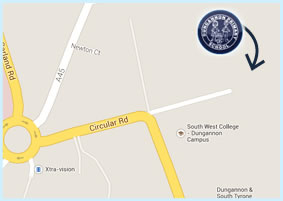
Dungannon Primary School,
Circular Rd,
Dungannon,
County Tyrone,
BT71 6BE
T: 028 8772 2250